
A VUCA world..wait, a what?
The world is always changing...

Consider the world as it is today—economically, politically, technologically, and culturally. How much of a resemblance does it bear to the world of twenty years ago? How about ten years ago? Five? Two?
We used to be able to draw clear lines between decades marking major social shifts. Picture the eighties: a decade of excess, hard rock, huge hair, and the fall of the Berlin Wall. The 90s was a return to counterculture, the dotcom boom and bust, Tamagotchis and Y2K fears. But the 2000s? That’s when it gets harder to pin down. As for the 2010s and ‘20s, it feels more and more like we’re squeezing a decade’s worth of innovation and industry upheaval into every eighteen months.
Demand for change is accelerating beyond our capacity to keep pace. Industry environments used to be stable for four to five years—enough time to read the market, set out a three-year plan, and execute it. Nowadays, you’d be lucky to get six months of stability regardless of your industry.
We once believed the earth was the center of the universe, until Copernican theory redefined how we saw ourselves in relation to the sun and stars. Likewise, the days of the customer coming begging to the organization are over. Steve Denning wrote in 2018 that the world no longer revolves around the organization; the customer is the new center of the universe and the organization needs to come to them.
What happened to make the world this way? We could point our fingers at any number of culprits. Technological advances are the most obvious cause: global digitalization, the rise of artificial intelligence, and industrial robotization have accelerated every aspect of industry. As this evolved, customers have accelerated their expectations in turn, and in fact their expectations now transcend industries. On the other hand, we face a series of constant, overlapping and intersecting crises that make it harder and harder to meet these needs: climate change, financial crisis after financial crisis, the rise and fall of global superpowers…
VUCA - the Acronym for the digital age..
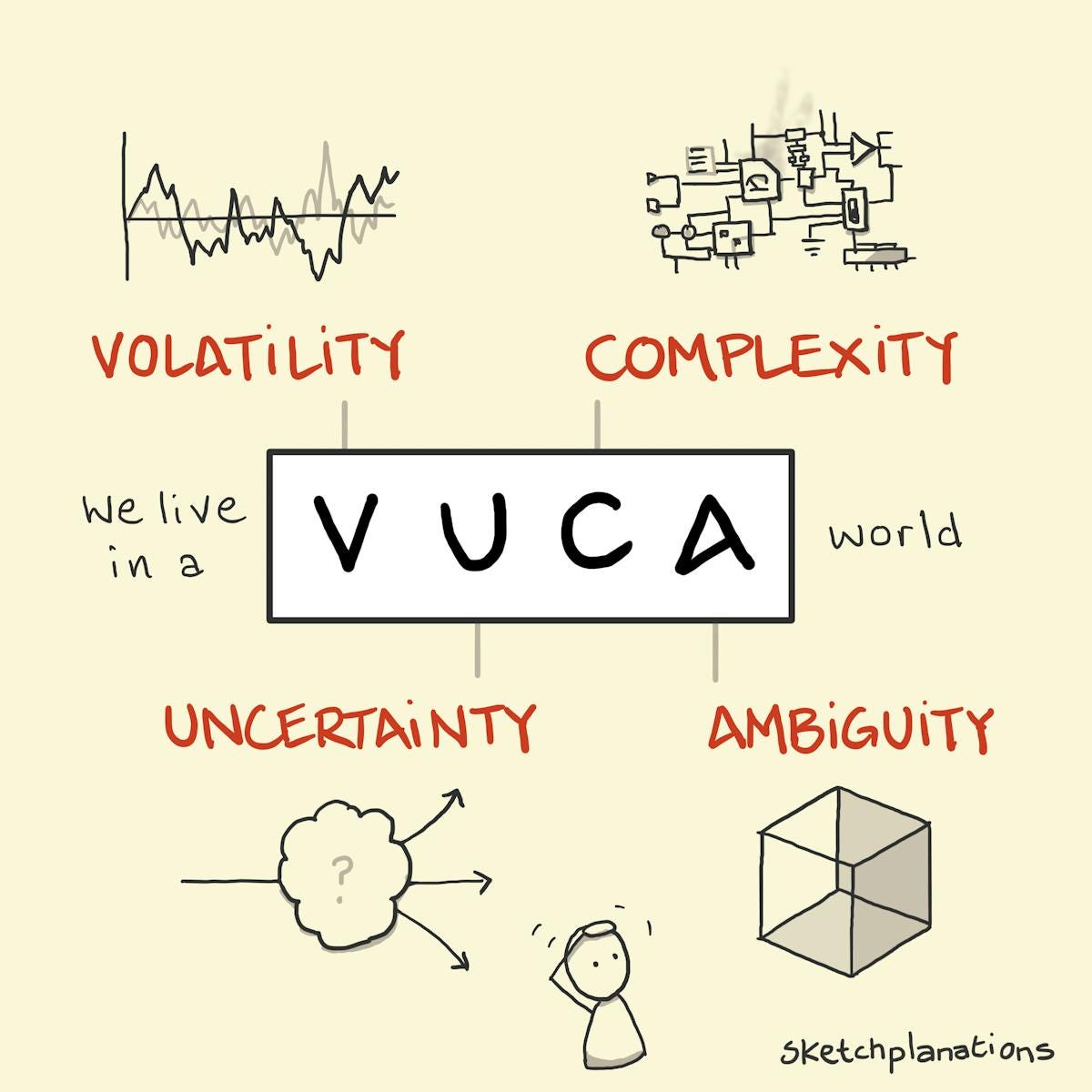
1Add all these factors together and you have a world that’s increasingly VUCA: Volatile, Uncertain, Complex, and Ambiguous. We can’t go any further without laying the groundwork on VUCA: where the term comes from, what it means beyond the acronym, and how it affects the way we work and govern.
VUCA was first used in the mid-80s by economists and university professors, Warren Bennis and Burt Nanus2, to describe the challenges and consequences of external factors upon corporate leadership. If only they’d known how much more VUCA things would become over the following decades! VUCA then became used by the US Army War College to describe the political, social, and military environment after the collapse of the Soviet Union. The old-world order of predictable cause and effect behaviors was gone. Prisoner swaps on Berlin’s Glienicke Bridge were swept away in an overwhelming wave of Perestroika and Glasnost.
In the early 2000s, VUCA once again found a foothold outside the military. With the fears and doubts of Y2K in the rear-view mirror, tech development and big data accelerated. With that acceleration came fresh challenges in an exponentially complex and interdependent world.
The foot never lifted from the pedal. VUCA is everywhere. Go to any agile or ways-of-working conference and every speaker will kick off their presentation with a spiel about the world being a VUCA environment (in fact, we do it all the time). It frames how we think about the need to bring agility to our work and remove the constraints we, at the time meaningfully, embed to create sustainability in revenue and operations. And it matters to how we think about Governance.
Why does VUCA matter to Agile and Governace?
Return to our first post here where we describe Our method of Agile Governance.
Agile Governance is achieved this by moving the focus of working methods away from processes and tools, and further towards individuals and interactions. Agile Governance empowers and accelerates information flow across an entire organization, rather than targeting specific teams or departments.This means the time taken for an idea to become a decision, to become an action, and then to become an outcome, is minimized—crucial, when the world is changing faster than we can react. In fact, an old colleague of ours used to say, “Problems change faster than we can develop and deploy the solutions to solve them”.
If this is a topic you are interested in exploring further, you can purchase the book “Govern Agility”; or you can peek behind the paywall for more of this content!
Keep reading with a 7-day free trial
Subscribe to Govern Agility to keep reading this post and get 7 days of free access to the full post archives.